Threading the C3 Inquiry Arc
C3 Dimension 1 and EAD Theme 7
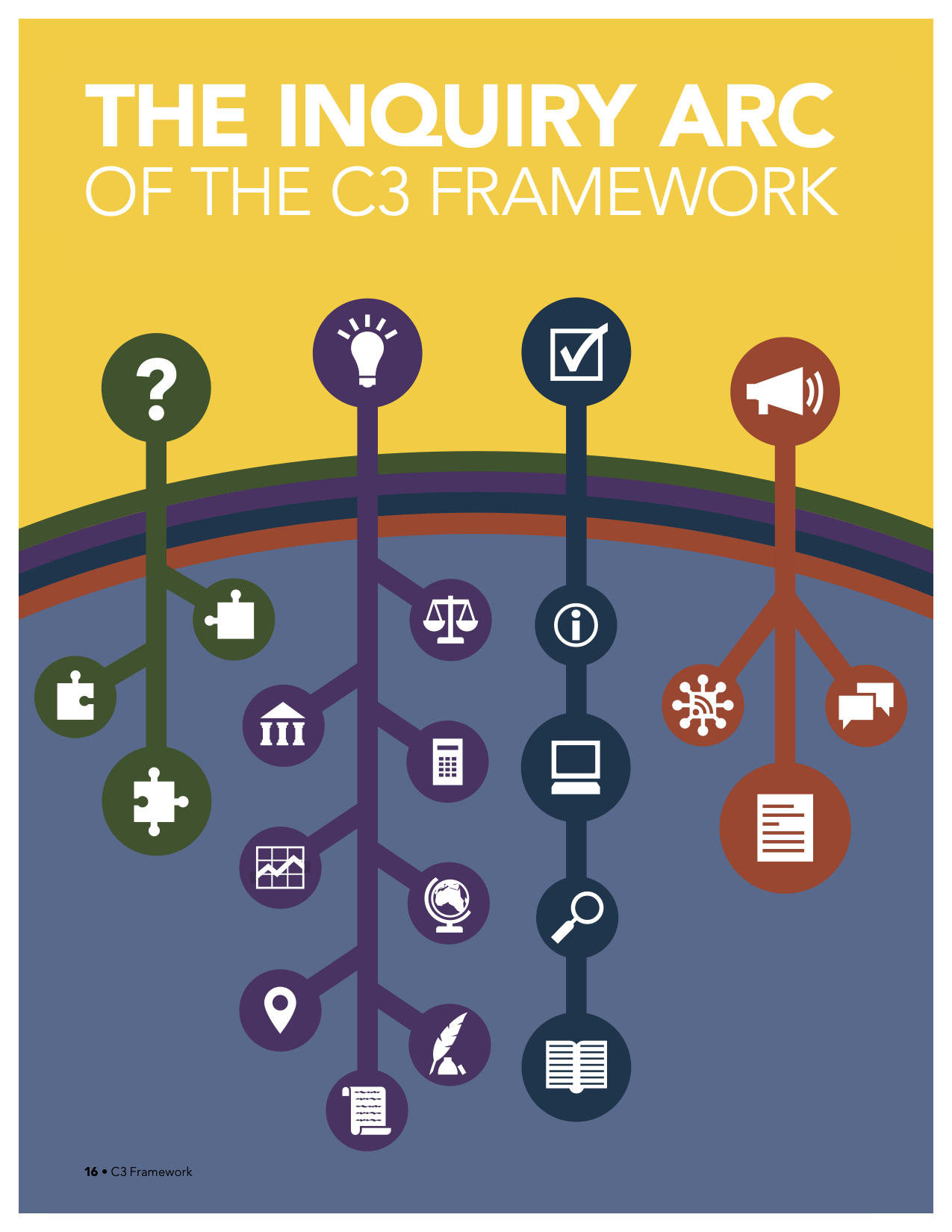
The seventh theme in the EAD Roadmap, A People with Contemporary Debates & Possibilities, was not included in our Content Spools because it deals with pedagogy, not content. It is a useful guide to teaching and learning healthy civic dispositions, with great ideas for opening (or closing) instructional units with questions that compel classroom discussion and friendly debate. This couples well with the first phase of C3’s Inquiry Arc (D1), “Developing Questions & Planning Inquiries”.
C3 Dimension 2 and Lesson Content
We refer to this Dimension 2, “Applying Disciplinary Concepts & Tools”, as the thinking standards. It is the direct companion to content standards and learning objectives, giving us the “how” to the “what”. Happily, the push for improved civic education has resulted in numerous non-profit sources beyond adopted textbooks for lesson content that align with EAD and C3.
C3 Dimension 3 and Literacy
Dimension 3 (D3) is “Evaluating Sources & Using Evidence”. Analysis of primary sources should follow acquisition of contextual knowledge. The recent trend to launch students into primary sources as a means to serve the ELA directive of evidence-based writing skill is misguided. Without transfer of requisite knowledge to build the context, document-based questions are a trivial pursuit and do not serve the true purpose of the history course. Curriculum maps by Civic Learning Threads™ schedule primary source analysis at key points in the unit learning plan when students can make the vital connections to the broader topic.
C3 Dimension 4 and Student Product
The fourth and final dimension (D4) is “Communicating Conclusions & Taking Informed Action”. The communicating and critiquing conclusions part provides thinking standards for argumentation for product such as end-of-unit essays. The “taking informed action” set provides standards for experiential project work.