Standards Alignment
The challenge of assessing for civic learning is partially due to an array of standards sets, and common misunderstandings about the varying purposes of standards. Such confusion can lead to ineffective district-level assessment initiatives. To effectively and meaningfully assess for civic learning in a way that provides valid data, we should track students with three assessment domains: Knowledge, Thinking, and Literacy. Civic Learning Threads™ aligns your curricula with a useful standard set for each: the content standard, the analysis skill standard, and the literacy standard.
Knowledge: Content Standards
Content standards comprise the essential knowledge students need to build understanding, in order to meaningfully analyze, synthesize, or conduct inquiry. A student cannot demonstrate academic skill if they do not acquire knowledge about the topic on which a performance task is based. Therefore, we list Knowledge first among the three assessment domains.
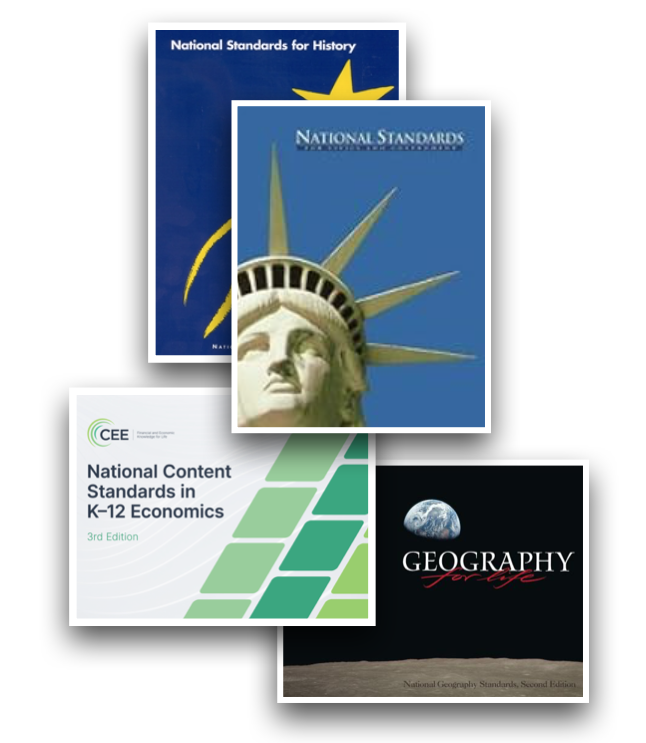
Many states have content standards for history, civics, geography, and economics. However, we have found that several states lack adequate social studies content standards, especially in history. For states that lack sufficient content standards, we fall back on national content standards for a given subject:
History - National Center for History in the Schools at UCLA:
Civics: National Standards for Civics and Government: - Center for Civic Education
Economics: National Content Standards for K-12 Economics - Council for Economic Education
Geography: Geography for Life: National Geography Standards- National Council for Geographic Education
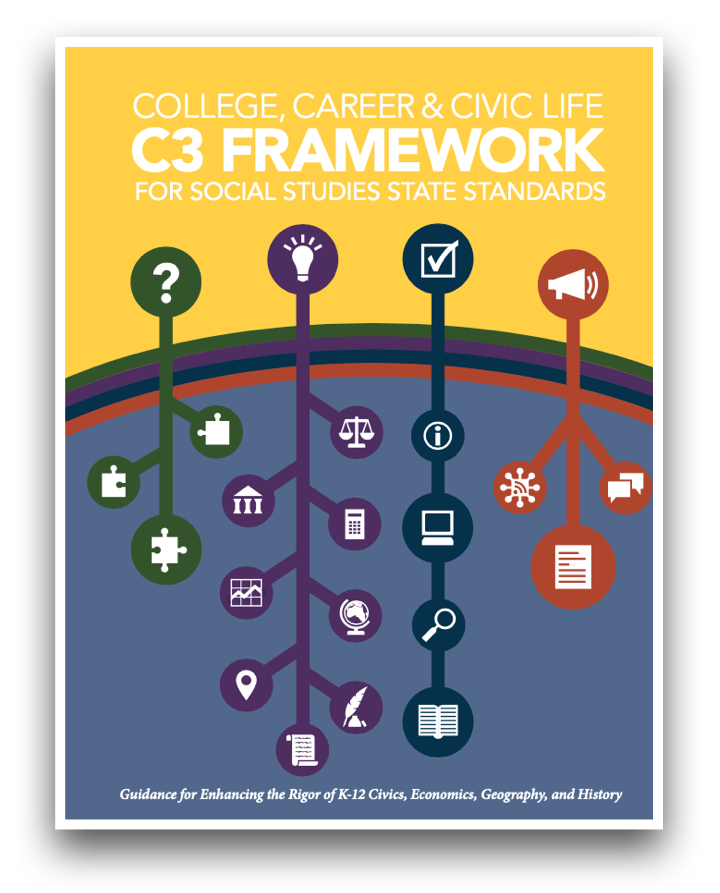
Thinking: The C3 Framework
All learning objectives require cognitive processes such as identifying chronology, describing sequence, analyzing causation, evaluating impact, formulating a claim, taking and defending a position, to name just a few. Also referred to as analysis skills, these are outlined in the College, Career, and Civic Life (C3) Framework for Social Studies State Standards: Guidance for Enhancing the Rigor of K-12 Civics, Economics, Geography, and History, published by National Council for the Social Studies (NCSS).
While the C3 Framework is organized around an “inquiry arc”, the disciplinary tools and skill standards are adaptable to any pedagogy. Many, if not most states have adopted C3 in part or in whole into their social studies standards. Where that is not the case we default directly to C3’s published framework.
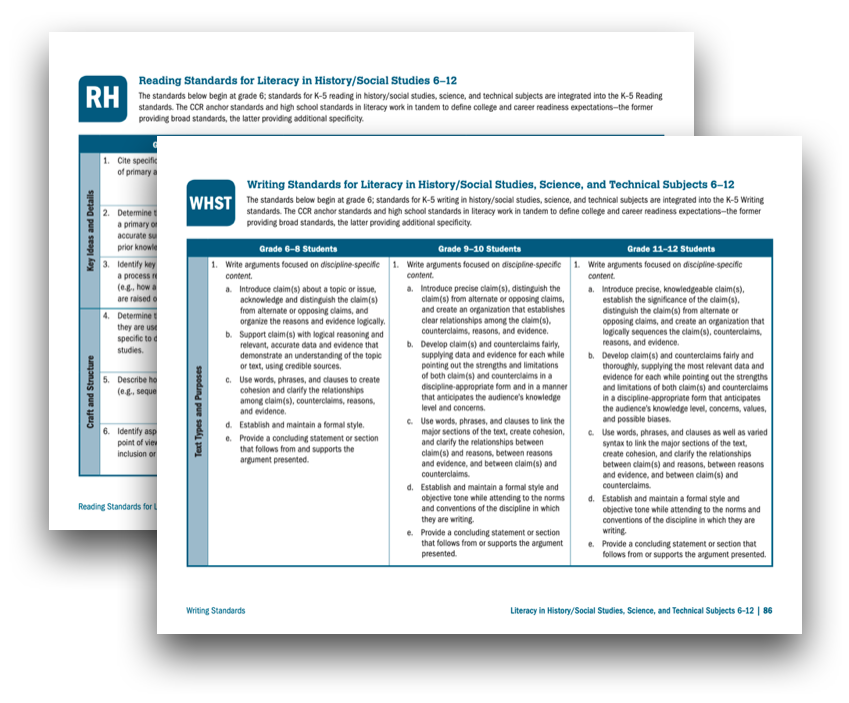
Literacy: Common Core State Standards
Nearly all states have adopted the Common Core ELA standards in some form. Civic Learning Threads emphasizes a reduced, more focused set within the CCSS for Literacy in History/Social Studies as they are relevant to student product in history/social studies courses.
Reading in History / Social Studies: Grade 6-8 | Grade 9-10 | Grade 11-12
Writing in History / Social Studies: Grade 6-8 | Grade 9-10 | Grade 11-12